Last updated October 31, 2026
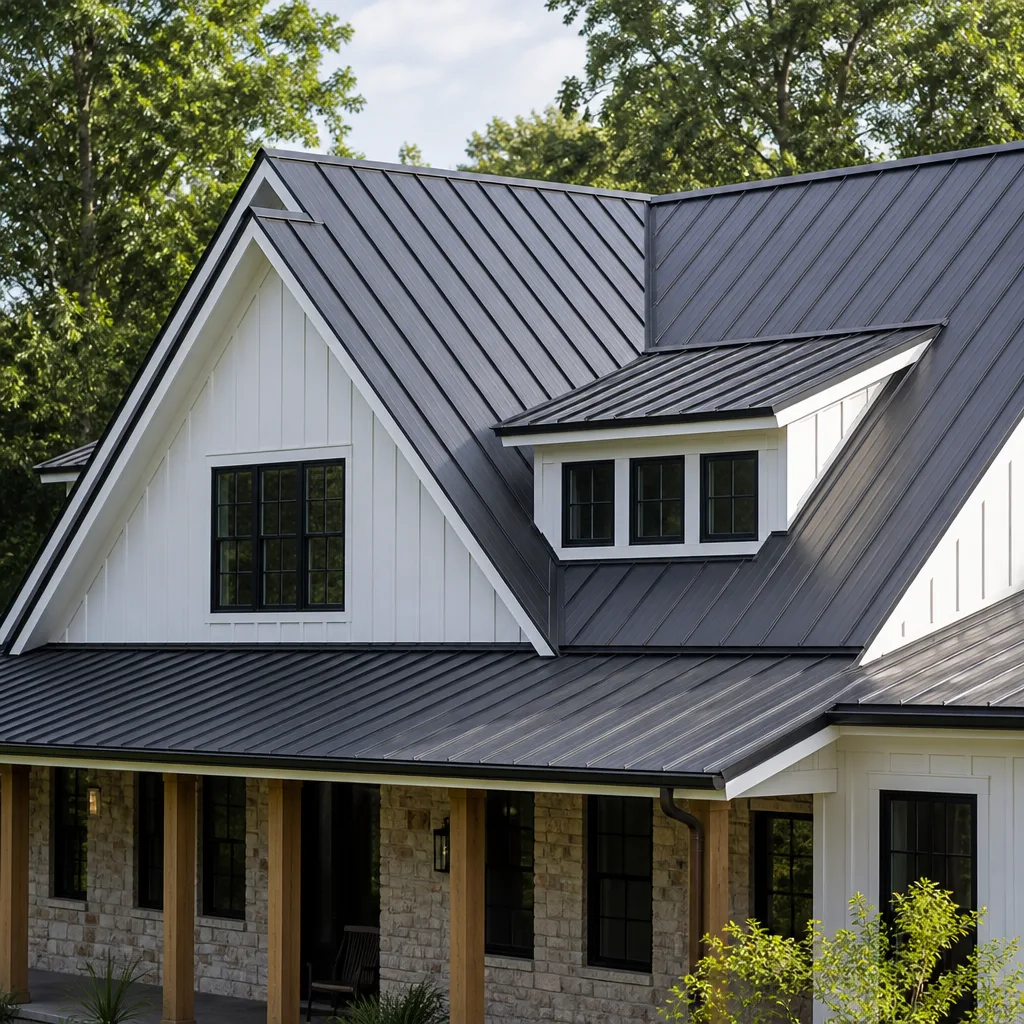 Metal roofing
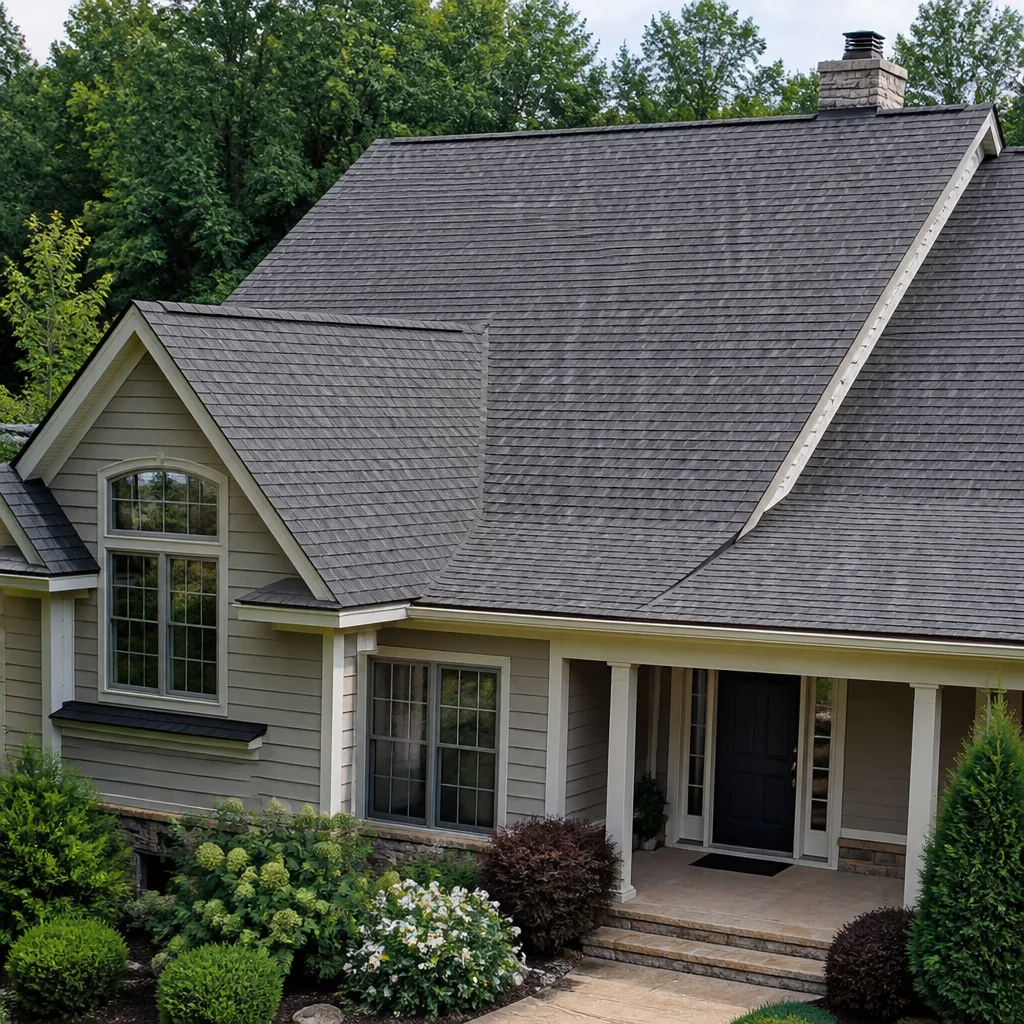 Architectural shingles
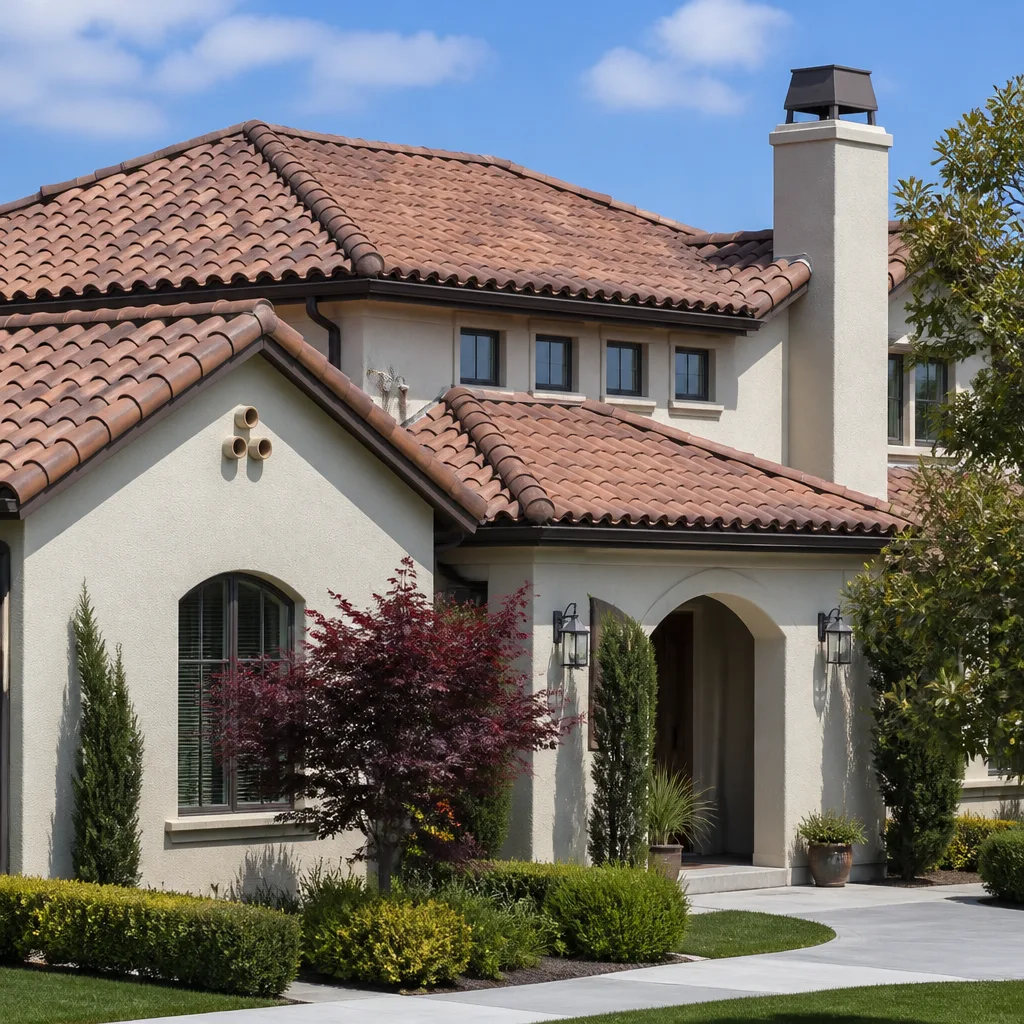 Tile roofing
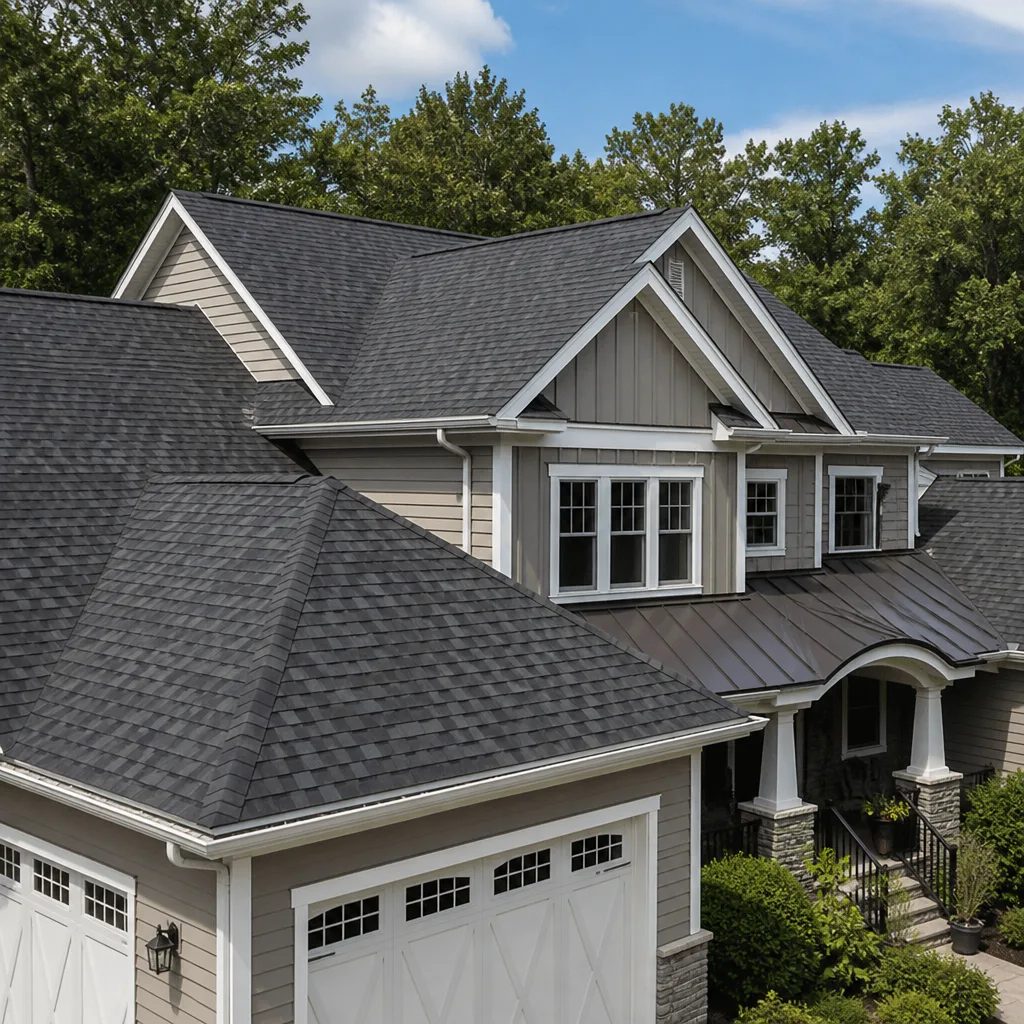 GAF
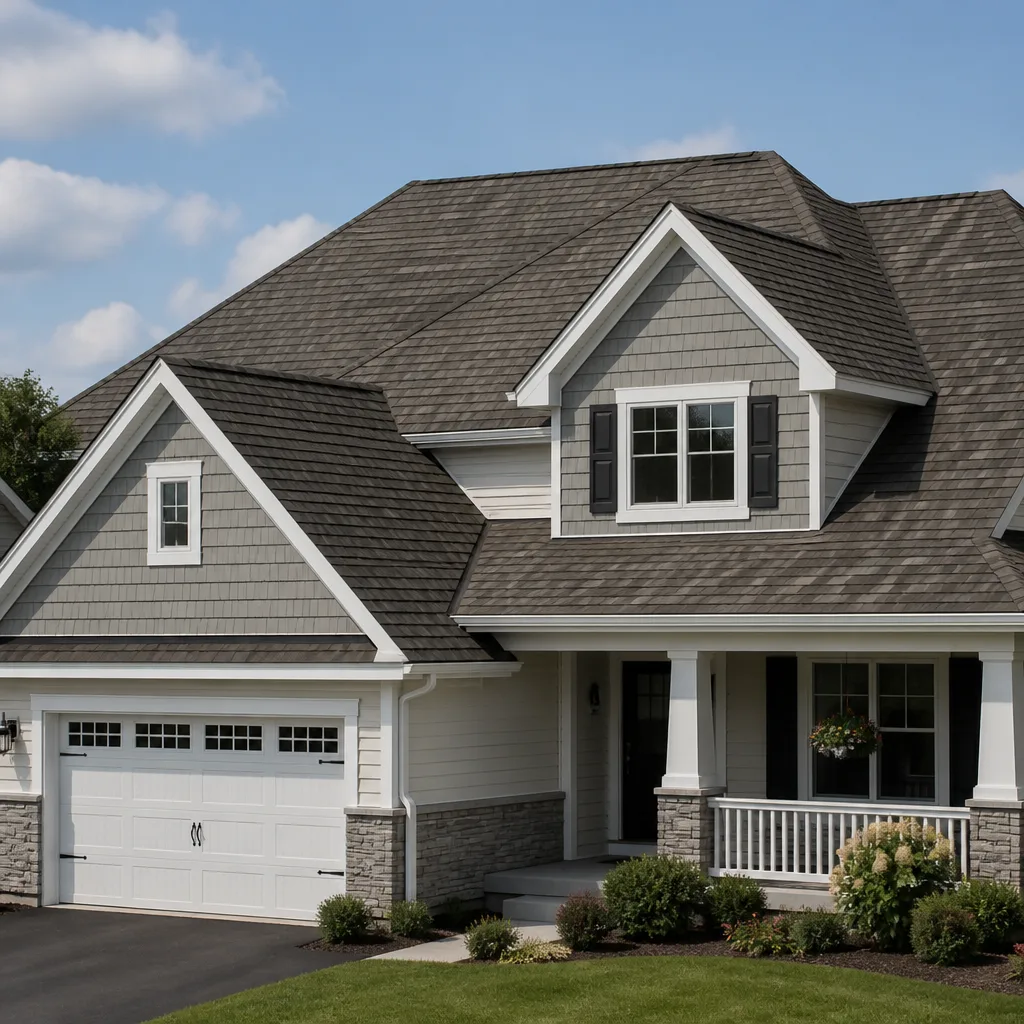 Owens Corning
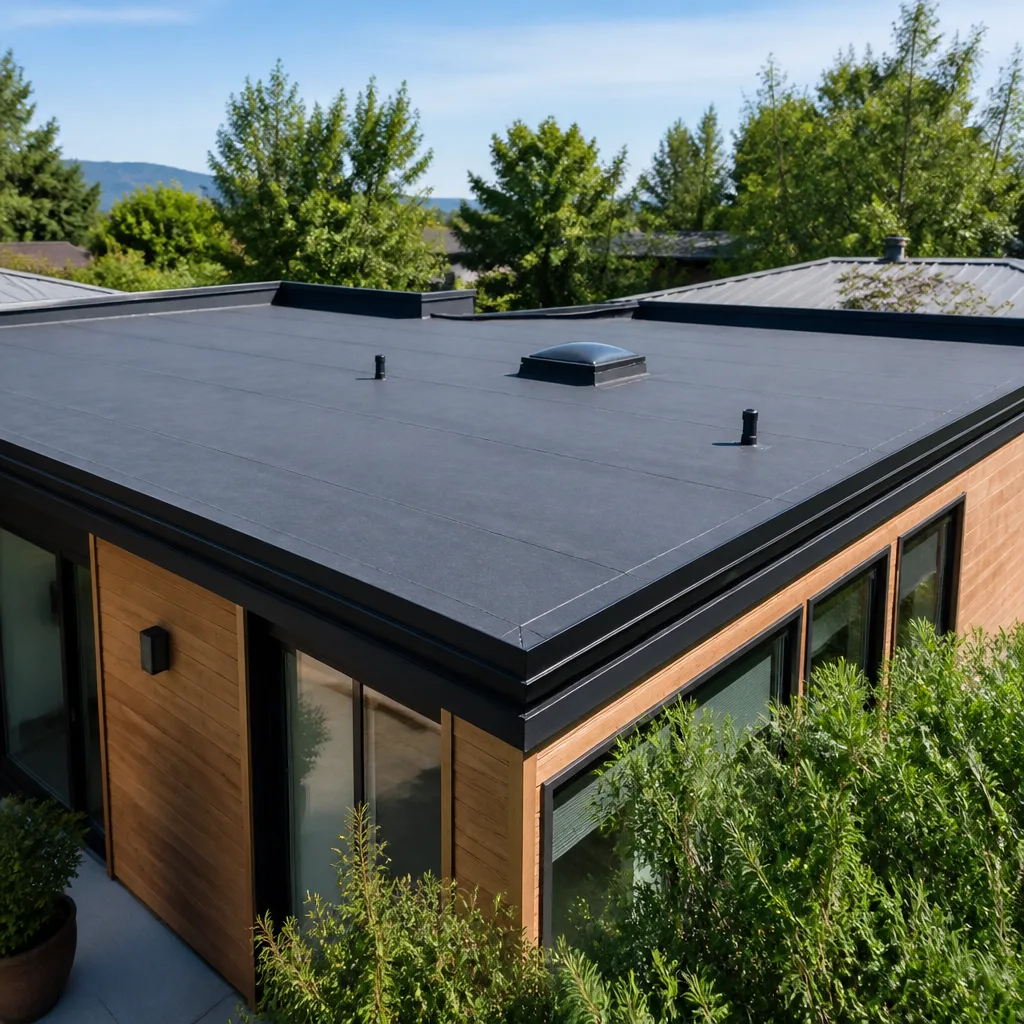 Flat & low-slope
Free roof inspection with deck photos before we talk money - GAF and Owens Corning certified installation
DIY vs Professional Roofing: The Orange Homeowner’s Decision Guide
Most homeowners who attempt their own roof repair in Orange fixate on the wrong variable. They price out shingles and underlayment, watch a few videos, and convince themselves the savings justify the risk. What they rarely consider is a California-specific consequence that can dwarf any upfront savings: an unpermitted roofing alteration creates a title defect that shows up during escrow and can compel a licensed contractor to tear off your handiwork before the sale closes. In a market where Orange homes regularly transact above the million-dollar mark, that escrow stall is not a hypothetical. It’s a documented pattern. This guide walks through the legal framework, insurance realities, realistic cost math, and the repair-vs-replacement calculus so you can make a decision you won’t regret in five years. For more guidance, see our Roof Repair Troubleshooting: Common Problems and How to Fix Them. If you own a home in Orange and you’re staring at a leaking flashing or a missing ridge cap, read this before you rent a nail gun.
Quick Answer
DIY roofing work in Orange is legal for homeowners only if the job meets narrow California exemptions and you personally perform the work on a home you occupy; but the larger issue is financial, not physical. Insurance carriers can deny claims on unpermitted or unlicensed roofing work, and unpermitted alterations become a recorded title issue that follows the property through any future sale. The practical rule: isolated shingle replacement and minor flashing sealant are acceptable DIY scope; any repair involving underlayment, structural decking, valleys, or more than a modest patch should go through a licensed C-39 roofer, because the cost of professional correction after a failed DIY job is typically two to three times what the original repair would have cost. See Roof Repair Maintenance Checklist for Orange Homeowners for a full scope breakdown.
Styles & brands we work with
Table of Contents
- What California Law Actually Allows Homeowners to Do
- How DIY Roofing Affects Your Insurance and Warranty Coverage
- Repair Scopes That Are Genuinely DIY-Appropriate
- Repairs That Look Simple But Are Not
- The Real Cost Comparison: DIY vs Professional
- Repair vs Replacement: Why the Risk Calculus Changes
- What Orange’s Climate Means for Your Roofing Decision
- The Permit Process in Orange: What You’re Actually Signing Up For
What California Law Actually Allows Homeowners to Do
California Business and Professions Code Section 7044 contains the owner-builder exemption that lets a homeowner perform work on their own residence without holding a contractor’s license. The statute is narrower than most people assume. You must personally perform the work or hire direct employees you supervise. You cannot hire a handyman without a contractor’s license to do roofing on your behalf, no matter how capable that person seems. The exemption exists so owner-occupants can maintain their own homes, not so you can quietly serve as an unlicensed general contractor on your own property.
Separate from licensure is the permit requirement. In Orange, as throughout most of Southern California, a roof replacement that involves removing the existing roofing material down to the sheathing requires a building permit from the city’s Building Safety Division. A repair of less than a certain square footage may fall under the maintenance exception, but the line is fact-specific. If in doubt, ask the building department directly. We regularly field calls from Orange homeowners who assumed a “small repair” sidestepped the permit process and later learned during a refinance or sale that the assessor’s record and the actual roof condition no longer matched.
The practical carve-out for minor work exists. Replacing a handful of broken shingles, resealing a vent pipe boot, or patching a small section of flashing is generally viewed as routine maintenance in Orange. What triggers scrutiny is anything that alters the roof system’s water-shedding assembly: underlayment replacement, valley reconfiguration, skylight curb work, or any torching of new membrane. Those are the jobs where an unpermitted condition becomes a real liability. The city’s enforcement is complaint-driven and escrow-driven, meaning you will not necessarily get caught during the work. You will get caught when the transaction requires disclosure.
The C-39 classification matters more than homeowners realize. California requires a roofing contractor to hold a C-39 license issued by the Contractors State License Board. That license carries bonding and insurance requirements that protect the homeowner if something goes sideways. A handyman at $35 an hour who offers to “do the roof” cheaper is not conducting a legitimate business in Orange, and the financial exposure shifts entirely to you if the work fails or injures someone. If you are going to hire anyone rather than do it yourself, verify the C-39 before the first ladder goes up. Our How to Hire a Roofing Contractor in Orange: A Step-by-Step Guide covers exactly what to check.
How DIY Roofing Affects Your Insurance and Warranty Coverage
The insurance conversation is where DIY roofing decisions in Orange usually break down. Most homeowners policies in California contain language tying coverage to “professional installation” when a roof is replaced, and increasingly when it is substantially repaired. If you replace your own roof and a wind event tears off a section two years later, the adjuster’s first question is not about the weather. It is about who installed the roof and whether the work was permitted. An unpermitted owner-installed roof gives the carrier a legitimate denial path that a licensed contractor’s work does not.
The permitting linkage is not subtle. Insurance carriers treat an unpermitted roof as a material change to the insured structure that was not disclosed at the time the work was performed. That is not a policy exclusion buried in fine print. It is a standard underwriting position across the major carriers writing policies in Orange County. Even if the initial claim is approved, the renewal quote may reflect the unpermitted condition, or the carrier may decline to renew altogether. The savings from DIY installation can evaporate in a single renewal cycle.
Manufacturer warranties work the same way, only with more rigidity. A GAF or CertainTeed shingle warranty does not fail outright on owner installation, but the coverage is typically reduced to a limited material-only warranty with no labor component and no coverage for installation errors. The meaningful warranties, the ones that actually protect you from a bad roof, are tied to installation by a manufacturer-certified or otherwise qualified professional contractor. We work with seven major shingle brands, including GAF, CertainTeed, Owens Corning, and IKO, and the warranty structure is consistent across all of them: the product warranty is stronger when the installation is professionally documented. The material is the material. The coverage depends on the hands that put it down.
Repair Scopes That Are Genuinely DIY-Appropriate
A capable Orange homeowner can handle a narrow set of roofing maintenance tasks without creating legal or insurance exposure. The standard for capability is not “watched a video” but rather “comfortable working from a ladder with both hands, and able to identify the roof assembly’s components by sight.” If you can walk your own roof and name the ridge, the valleys, the flashing locations, and the penetration points, you are in the range where minor DIY work is defensible. If you cannot, you are not.
Here is the short list of DIY-appropriate repair scopes for a homeowner in Orange:
- Replacing a single broken or missing asphalt shingle on a low-slope section where you can reach the area without standing on wet or steep decking.
- Resealing a pipe boot or small flashing seam with an appropriate roofing sealant, applied to a clean, dry surface.
- Clearing a debris dam from a valley or behind a chimney, which is a maintenance task more than a repair but prevents the leaks that follow.
- Re-nailing a lifted shingle tab where the nail has backed out and the shingle is otherwise intact.
- Applying a temporary tarp after a storm event to prevent interior damage while waiting on a professional assessment.
None of these tasks requires a permit in Orange, and none of them alters the fundamental water-shedding assembly of the roof. They are maintenance items, and insurers do not treat them as material changes. The common thread is that all of them leave the existing roof system essentially as it was, just restored to the way it should have been. The moment you start removing underlayment, rebuilding a valley, or re-flashing a chimney, you have crossed from maintenance into construction.
Repairs That Look Simple But Are Not
The most expensive DIY mistakes we correct in Orange homes are the ones that looked visually simple from the ground. A homeowner sees water staining on a ceiling, climbs up, notices what appears to be one cracked shingle, replaces it, and the leak persists through the next rain. The actual entry point was four feet uphill, where a nail had backed out of a flashing seam. The shingle was the symptom. This pattern repeats constantly because roofs hide the relationship between entry point and exit point. Water travels under the decking, along the underlayment, and surfaces far from where it penetrated.
Here is the list of roofing repairs that should never be DIY, regardless of capability:
- Valley replacement or repair. Valleys concentrate more water than any other part of the roof, and the weaving or metalwork required is unforgiving. A valley done wrong leaks within months, and the failure point is often invisible until drywall damage appears.
- Chimney, skylight, or dormer flashing. These penetrations require multiple flashing components stepped in a precise order. If the sequence is wrong, water wicks uphill and into the roof cavity.
- Any repair involving underlayment. If a shingle is gone and the underlayment below it is torn, dried out, or missing, you are no longer doing repair. You are doing a localized re-roof, and that triggers the permit angle in Orange.
- Structural decking repair. Rotted sheathing is a structural issue. Patching it without understanding load paths, moisture barriers, and the nailing schedule for the surrounding roof creates a failure point that worsens over time.
- Any work on a steep-slope roof above 8:12. At that pitch, OSHA would require fall protection for a professional crew. The physics of working safely on a steep Orange roof are not solved with a rope and a prayer.
- Full tear-off and replacement. This is not a DIY discussion at all. The permitting, the material selection, the tear-off disposal, and the installation sequence make it a licensed-contractor job, full stop.
If you are standing in front of any of these six scopes and weighing DIY, shift your analysis. The relevant question is not whether you can physically perform the work. It is whether you are willing to carry the full liability for a leak that may not reveal itself for eighteen months, and whether your insurer will stand behind a claim arising from a roof you rebuilt yourself. In our experience with Orange homeowners, the answer is usually a quiet no.
The Real Cost Comparison: DIY vs Professional
Let’s run the numbers on a representative repair: a small section of roof around a plumbing vent where the flashing has failed and a few shingles need replacement. This is a job a professional crew in Orange completes in a partial day. A homeowner doing it right, with the correct materials, will spend roughly the following:
- Materials: $80 to $220 for a bundle of matching shingles, sealant, flashing, and fasteners.
- Tool rental or purchase: $40 to $150 for a proper roofing nailer rental, ladder stabilizer, and safety harness if you don’t already own them.
- Time: A full day to a day and a half when you count the material runs, the setup, the work itself, and the cleanup.
- Disposal: $35 to $75 for old shingle debris if you cannot fit it in your regular trash pickup.
A licensed professional quoting the same repair in Orange would typically land between $450 and $800, depending on roof access and material match complexity. The DIY savings look real on paper: maybe $250 to $400. But that calculation omits the failure margin. If the homeowner’s repair leaks, the ceiling repair alone often costs double the quoted roofing work, and the roofing correction is a second labor charge on top of that. The honest math is that DIY roofing is a bet with asymmetric downside. You are risking thousands to save hundreds.
For a full roof replacement, the numbers dwarf the repair comparison. A permitted, licensed roof replacement on a typical Orange home runs into five figures, depending on size, pitch, material selection, and tear-off complexity. The permit fee from the city is a line item most DIY cost estimate videos conveniently forget: Orange’s building permit fees for reroofing, including plan check when applicable, add a few hundred to a couple thousand dollars to the job. A DIYer only avoids that fee if they skip the permit, which is precisely the unpermitted-work liability we have been describing. The permit is not a tax on the honest. It is the documentation that keeps your roof legal, insurable, and sellable.
The tools and learning curve represent another hidden cost that rarely surfaces in the YouTube thumbnail. A professional roofing crew has thousands of hours of muscle memory across every roof geometry Orange homes present. A homeowner doing their first roof will waste material, mis-drive fasteners, and sequence the underlayment incorrectly in ways that are not visible from the curb. The material waste alone on a first-time DIY replacement can hit 10 to 15 percent, which on a $6,000 material order is $600 to $900 of waste before the first leak is even considered.
Repair vs Replacement: Why the Risk Calculus Changes
Homeowners in Orange frequently blend the DIY-versus-pro decision with the repair-versus-replace decision, treating them as one question. They are not. The risk structure is entirely different depending on scope, and the two decisions deserve to be unbundled.
For a repair, the downside of a DIY attempt is bounded. You might spend a weekend and a few hundred dollars, misread the leak source, and end up calling a pro anyway. That’s a tuition payment, not a catastrophe. The worst realistic outcome is the leak persists and you get some additional ceiling staining before the professional fixes it. The right frame for repair work is a simple judgment call: if you can see exactly what failed, you can find an appropriate YouTube tutorial, and you are comfortable on the roof, a minor repair is within reach. If any of those three conditions is false, the call is $450 to $800 for a professional repair, and that’s a bargain compared to the alternative.
For a full replacement, the calculus inverts. A replacement is a five-figure investment that affects your home’s structural integrity, your insurance standing, your manufacturer warranty, and your future sale. The downside of a DIY replacement is not bounded at all. An unpermitted owner-installed roof in Orange can become a sale-delaying, claim-denying, renewal-threatening condition. The right frame for replacement work is not a judgment call. It is a qualified yes to a licensed professional, because the costs of doing it wrong attach to the property deed, not just to you.
Our recommendation at Windmill Roof Repair, which we apply to our own customers in Orange, is the honest-scoping principle we put on our own materials: repair when you can, replace when you must. A roof with ten years of serviceable life left does not need a $22,000 tear-off because one valley leaks. It needs a $900 valley rebuild. The roofing industry has a reputation for pushing premature replacement, and the only defense a homeowner has is an accurate, standalone assessment from someone without a financial stake in the upsell. That is why we offer roof inspection as its own service, with no requirement that the inspection lead to any contracted work. Roof inspection in Pico Rivera and surrounding Orange County communities should answer one question: what does this roof actually need right now?
What Orange’s Climate Means for Your Roofing Decision
Orange sits in a specific microclimate band that shapes how roofs fail here. We get modest annual rainfall, typically between 13 and 16 inches depending on the year, concentrated in a handful of storm events between November and March. The summer sun is the bigger structural pressure. Weeks of 90-degree-afternoon heat bake the asphalt shingle surfaces, accelerating the thermal cycling that eventually cracks tabs and degrades the adhesive sealant strips. The damage accumulates slowly, out of sight, until a winter storm pushes water through a brittle section that had already lost its flexibility.
UV degradation matters more for material selection than most homeowners expect. A dark architectural shingle in Orange will age differently than the same shingle in a coastal marine layer or a high-desert climate. The heat load on an unshaded, south-facing roof plane in Orange is meaningful. This is where brand selection stops being academic. A GAF or CertainTeed architectural shingle may carry a different effective lifespan on a fully exposed Orange roof than an Owens Corning or IKO product with a different granule formulation and asphalt blend. No single brand wins every climate, which is why we maintain a seven-brand lineup rather than pinning our recommendations to one manufacturer. The right material for a shaded, low-slope Orange ranch house may not be the right material for a fully exposed two-story near the 55.
The wildfire-adjacent concern is separate but related. Orange is not currently mapped into the highest fire severity zones the way parts of the foothills are, but the city sits within a region where ember-resistant roofing discussions are increasingly common. A Class A fire-rated assembly is standard across quality shingle lines now, but the assembly rating depends on the underlayment and decking details as much as the shingle itself. This is another argument against DIY replacement: a fire-rated assembly is a system, and the rating only holds if every layer is installed to the manufacturer’s specification. A homeowner buying shingles from a big-box store and laying them over a skip-sheeted deck without a rated underlayment is not getting the Class A performance the shingle package suggests.
The Permit Process in Orange: What You’re Actually Signing Up For
If you are leaning toward a permitted roof replacement through a professional, it helps to understand what the Orange permit process actually involves. The city’s Building Safety Division reviews reroofing applications for compliance with the current California Building Code and the city’s adopted amendments. A typical reroof permit in Orange includes a plan check on scope, an issuance fee based on valuation, and at least one mid-roof inspection plus a final inspection. The inspector verifies underlayment installation, fastener schedule, and flashing details before the shingles can go down, then signs off on the completed assembly.
The inspection is not a rubber stamp. Orange inspectors are specific about nailing patterns on re-decked sections, about valley construction details, and about the underlayment type required for the roof slope. A licensed contractor who works in Orange regularly knows what the local inspectors look for. A homeowner doing a first-time permitted replacement will likely fail the first inspection on a detail they did not know existed. A failed inspection is not a catastrophe, but it does mean the project stops, a re-inspection fee gets paid, and the correction gets made. In the professional trade, this is normal. For a homeowner, it is a stressful discovery process in the middle of a roofless house.
There is a legitimate path for a homeowner in Orange who wants to function as an owner-builder on a full replacement: pull the permit yourself, do the work yourself, get it inspected, close the permit. The law allows this. The question is not legality but competence and consequence. If you close the permit successfully, you have a legal, insurable roof, and you saved the labor cost. If you get halfway through and realize the scope exceeded your capacity, good luck finding a licensed contractor willing to take over an owner-builder permit. Most will not. The contractor inheritance problem is one of the least-discussed risks in the entire DIY roofing conversation, and in Orange it is as real as anywhere.
What Kind of Homeowner Should Consider DIY Roofing?
Notice we framed this section around repair, not replacement. The honest answer is that DIY roof replacement in Orange is rarely the right call for any homeowner, because the permit, insurance, warranty, and resale dynamics stack against it. But DIY repair has a legitimate audience, and we would rather describe that audience accurately than pretend it does not exist.
You are a reasonable candidate for DIY roof repair in Orange if all of the following are true:
- You own a single-story home with a walkable, low-slope roof, accessible with a standard extension ladder.
- You can identify the failed component visually: a cracked shingle, a lifted flashing seam, a dried-out pipe boot.
- You have done similar mechanical repairs before and own or can rent basic roofing tools.
- You are prepared to spend the time to do it carefully rather than rushing before dark.
- You understand that if the repair fails, you will be calling a professional and paying full price anyway.
You are not a reasonable candidate if any of the following apply:
- Your home is two stories or has steep roof sections, especially on the street-facing planes visible from Orange’s residential streets.
- You cannot locate the actual leak source from the attic or the roof surface.
- You have never done any structural or weather-exposed work on a house before.
- You are under time pressure from a pending home sale or an open escrow demand.
- Your insurer has already asked about the roof’s condition, or you suspect a claim may be coming.
The time-pressure scenario deserves emphasis. We regularly hear from Orange homeowners who received an escrow demand letter requiring a licensed roof certification before closing, and they ask if they can just “fix the shingles themselves” to satisfy the requirement. The answer in most cases is no, because an escrow holder or buyer’s lender typically requires documentation from a licensed contractor, not a homeowner’s affidavit. If the sale is the trigger for the roof work, the DIY window has already closed.
The Hidden DIY Costs Nobody Puts in the YouTube Description
The most-watched DIY roofing video we have seen, and we have seen enough to know the genre, never once mentions the line items that actually decide whether the project makes financial sense. Here is the full accounting a Orange homeowner should consider before touching a shingle:
- The correction cost. When a homeowner repair fails, the professional repair often requires undoing the homeowner’s work before starting, at an additional labor charge. You pay twice for the same roof section.
- The dump run. Full replacement tear-off debris cannot go in a standard residential bin in Orange. A roll-off rental or multiple dump runs add $400 to $900 to a project that a professional’s disposal line item covers.
- The tool depreciation. A roofing nailer, air compressor, ladder stabilizer, and harness system cost several hundred dollars minimum. You will not amortize that over multiple roofs as a homeowner; you will use it once.
- The lost free time. A professional crew tears off and reroofs a typical Orange home in three to five working days. A solo homeowner facing the same scope should budget three to five weekends, weather permitting, which in the middle of a SoCal winter is a real variable.
- The resale disclosure. If you sell while the DIY roof is still in place, the standard California transfer disclosure requires you to note owner-installed, unpermitted work. That disclosure alone can cost you more in negotiation than the professional labor would have cost.
The honest summary is this: the only DIY roofing projects that reliably save money are the minor repairs, under $300 in materials and a day of labor, where the alternative is a $500 to $800 professional repair. The savings are real but modest. Everything above that threshold, and certainly anything involving a permit, is a bet against long odds. We are not in the business of scaring homeowners away from understanding their own roofs. We are in the business of making sure the financial analysis they run is complete. Browse more guides & resources for additional Orange-specific roofing help.
Material Choice Complicates the DIY Question Further
If you do decide to hire a professional, the brand conversation in Orange is more nuanced than most contractors present it. The typical roofing sales pitch in Southern California goes one of two ways: the contractor is a certified installer for one brand and steers every customer toward it, or the contractor installs whatever the supply house has on the shelf this week. Neither approach serves the homeowner’s actual interests.
Our position at Windmill Roof Repair is built around the observation that roofing material selection is a genuine engineering decision, not a fashion choice. An Owens Corning Duration shingle and a GAF Timberline shingle are both excellent products, but they have different granule densities, different nailing strip configurations, and different warranties. The choice between them should turn on the specific Orange roof: its pitch, its sun exposure, its ventilation setup, and the homeowner’s intended tenure in the house. A homeowner planning to sell in three years has a different material calculation than one planning to age in place for twenty.
Because we work across seven major shingle brands, including GAF, CertainTeed, Owens Corning, and IKO, the recommendation we make is the product that fits the roof and the budget, not the product we are contractually obligated to push. The phrase we use internally is the right material for your roof, not ours. It is not a slogan; it is the structural principle behind why a material-agnostic contractor exists. If you cannot find another roofer in Orange who will give you an honest comparison of three different shingle lines for your specific roof, you have not found a material-agnostic roofer. You have found a distributor with a ladder.
This matters for the DIY-versus-pro decision in a specific way. A homeowner at a big-box store sees three shingle brands on the shelf and assumes they are interchangeable. A professional knows they are not. The difference shows up in wind uplift ratings, in algae resistance for shaded Orange roof sections, in impact resistance for homes under tree limbs, and in the warranty language that either protects you or does not. Material expertise is one of the places where professional labor genuinely earns its margin.
Orange Context: What Local Conditions Mean for Your Roof
Orange’s building stock deserves its own consideration in any roofing decision. The city has three distinct housing generations, each with different roofing challenges. The pre-war and immediate post-war neighborhoods, concentrated around the Plaza and the older streets east of Glassell, feature low-slope ranch roofs with limited attic ventilation and original decking that has often been skip-sheeted. The mid-century tracts that expanded through the 1960s and 1970s commonly have composition shingle over 1×6 or 1×8 decking, with the dimensional lumber now carrying five decades of thermal cycling. The newer hillside and master-planned developments, pushed up toward the eastern edges of the city, tend to have concrete tile or heavier architectural shingles on steeper pitches.
Each generation presents different DIY access realities. A homeowner in a single-story ranch near the Plaza can walk most of the roof safely with a step ladder and appropriate caution. A homeowner in a two-story hillside home with a 9:12 pitch on the rear plane faces a genuinely hazardous workspace. The roofing challenges in Orange are not uniform, and any DIY assessment that treats the whole city as one roof type is starting from a false premise.
We work throughout Orange and Orange County, and the repair patterns we see track the housing generation more than the specific storm. Older decks with poor ventilation suffer nail pops and underlayment drying. Mid-century decks with wider board gaps need specific underlayment choices to prevent wrinkling. Newer steep roofs see more flashing failures at the transitions where the roof geometry changes. None of this is visible from the street, and all of it affects the repair-versus-replace call. Roof repair in Pico Rivera and the surrounding Orange County area follows these same generational patterns.
Common Mistakes to Avoid
- Assuming the owner-builder exemption covers hiring a handyman. It does not. In California, hiring an unlicensed individual to perform roofing on your home is illegal, and the liability for injury or damage falls entirely on you.
- Skipping the permit on a large repair because “nobody will know.” The permit tracking is not about city enforcement in the moment; it is about the escrow review and the insurance claim review that will happen eventually. The unpermitted work surfaces.
- Treating a leak stain on the ceiling as identifying the roof leak location. Water travels. The stain is often ten to fifteen feet from the actual entry point, and fixing the area above the stain is a common and expensive misfire in Orange homes.
- Using the wrong sealant. Not all sealants are rated for roofing. Silicone caulk from the hardware store does not bond properly to asphalt shingles and will fail within a season in Orange’s heat-rain cycle.
- Underestimating the ladder and fall risk. Falls from roofs and ladders are among the most common serious home injuries in Southern California. A trip to the trauma center erases every dollar of DIY savings, and the injury can be permanent.
- Confusing a cheap quote with a cheap roof. The low bid in Orange often reflects an unlicensed crew, unpermitted work, or corner-cutting that will not be visible until the first storm. Verify the C-39 and the permit status before signing anything.
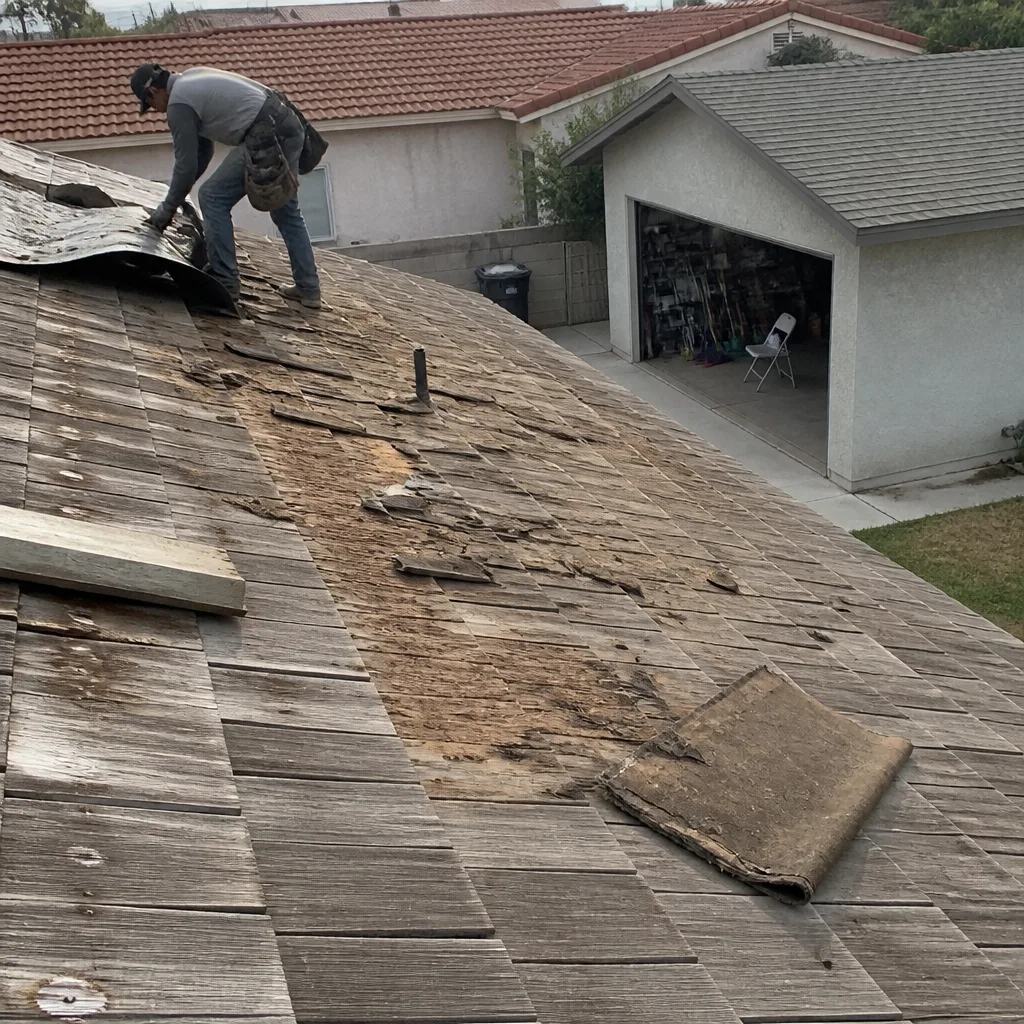
See the difference
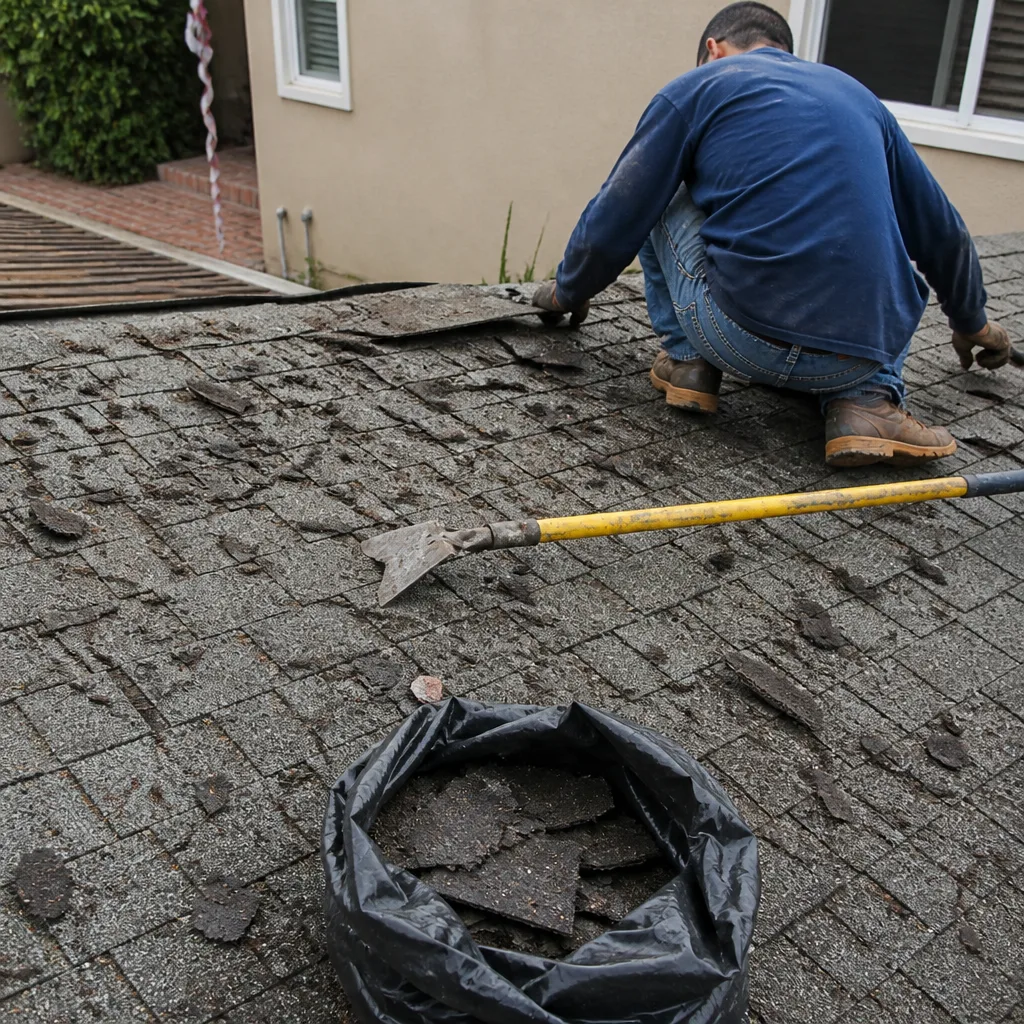 Before
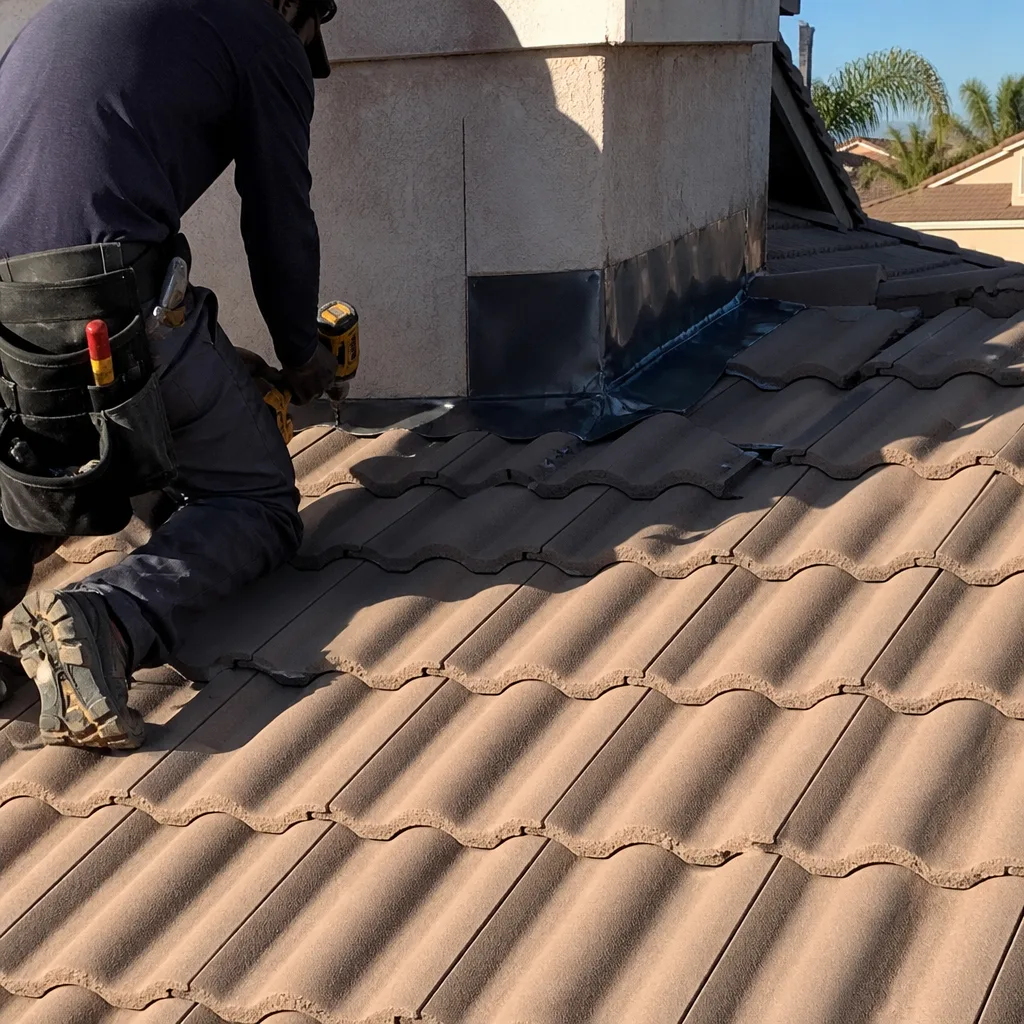 After
 Before
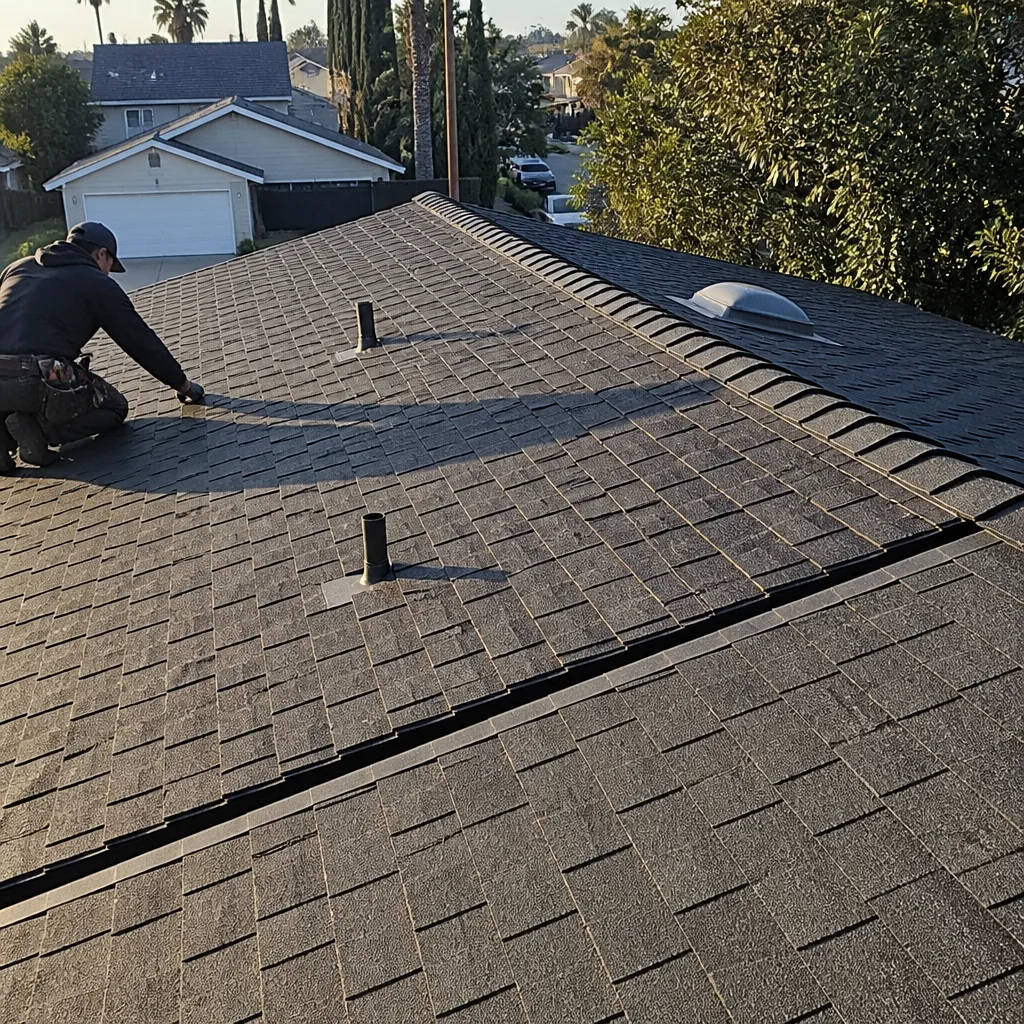 After
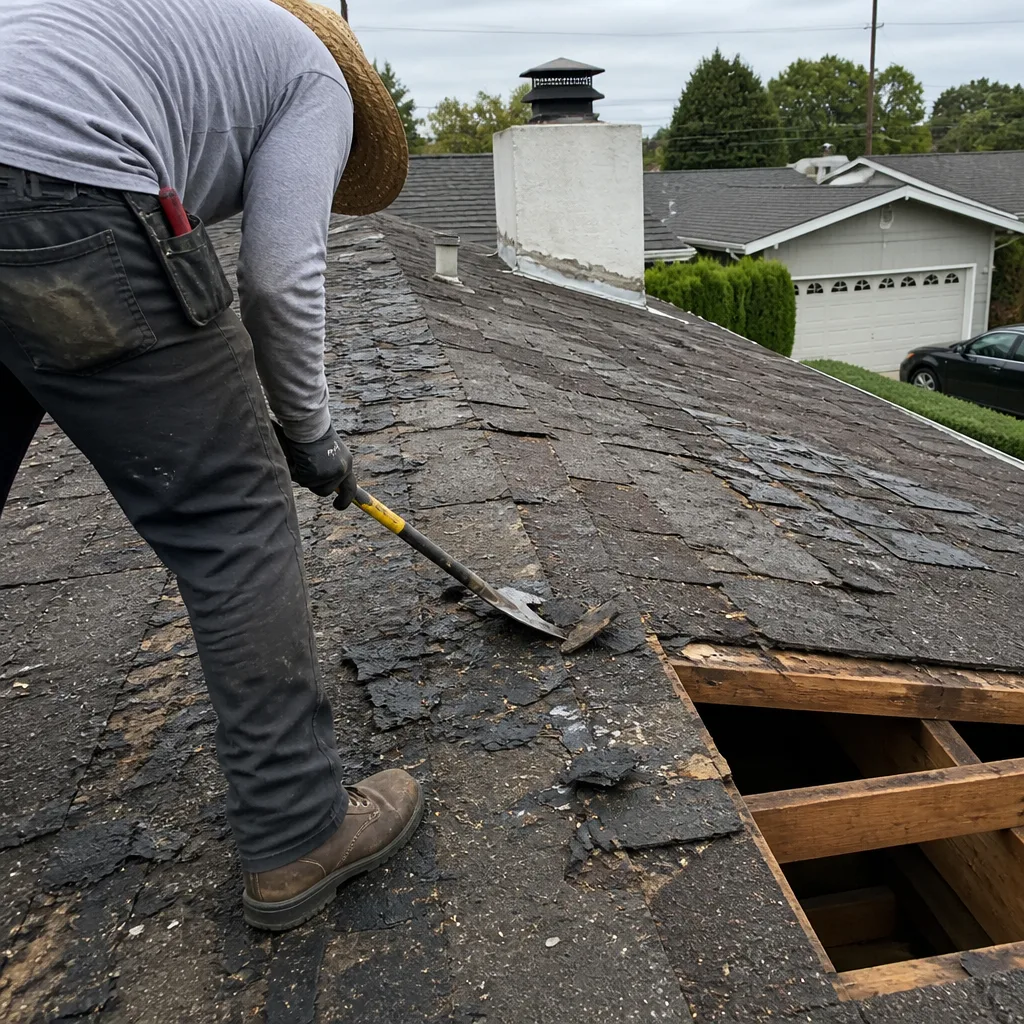 Before
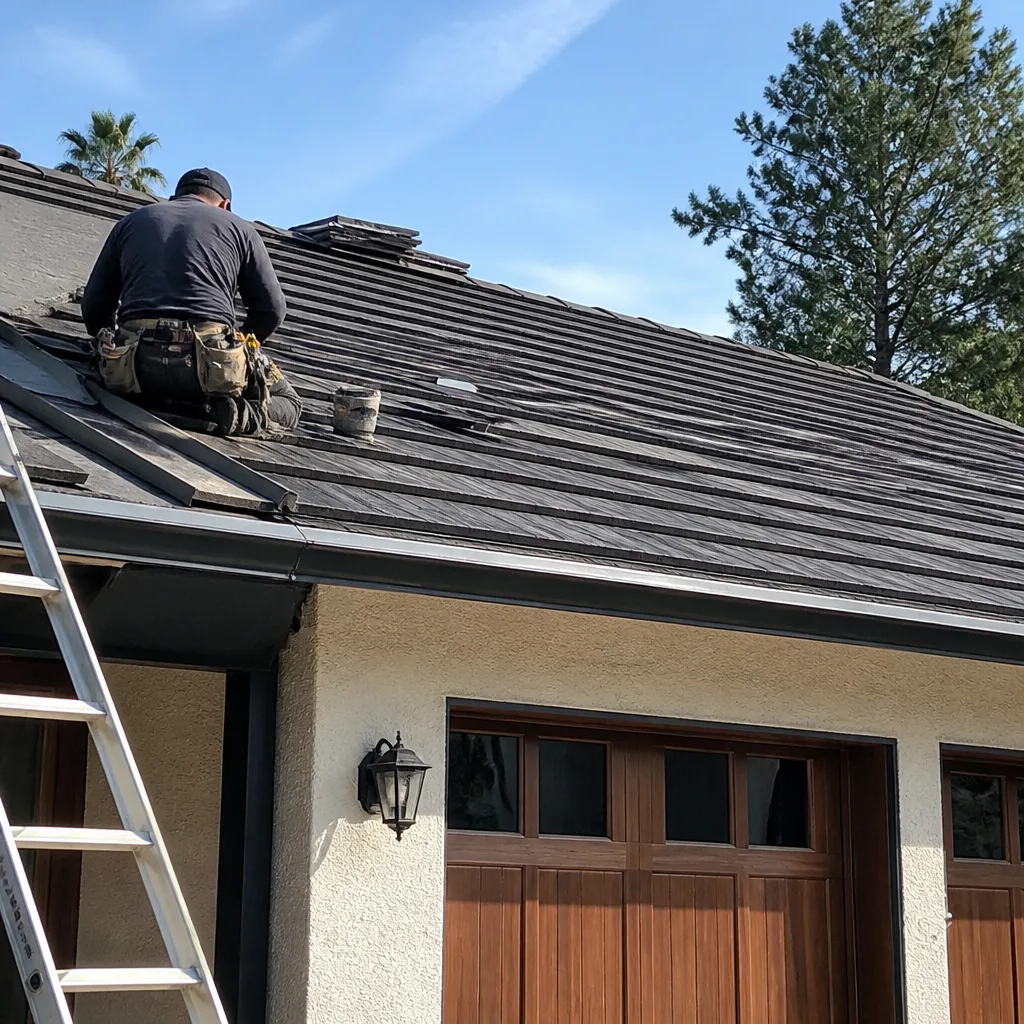 After
When to Call a Professional
The threshold for calling a professional is lower than most homeowners want it to be, and the calls we take from Orange homeowners who waited too long are consistent in their regret. Call a licensed roofer when the leak source is not visually obvious, when the repair requires removing underlayment or re-flashing a penetration, when the roof is steep enough that you feel any hesitation standing on it, or when a home sale is creating a deadline. Call before you damage anything further. Windmill Roof Repair offers free estimates in Orange, and we are happy to walk a roof and tell you honestly whether the repair is within reach or not. Roof replacement in Pico Rivera and nearby Orange area homes follow the same honest-scoping standard we apply to every roof we assess. Reach us at (866) 850-2496.
Frequently Asked Questions
Yes, California’s owner-builder exemption allows you to personally perform maintenance and repairs on a home you own and occupy, including minor roofing work that does not require a permit. The exemption does not cover hiring unlicensed help, and anything beyond routine maintenance in Orange may require a building permit and professional documentation.
A typical professional roof repair in Orange runs between $450 and $800 for a localized shingle or flashing repair, with more complex repairs such as valley rebuilds or chimney re-flashing running higher. The exact number depends on roof access, material match, and the extent of the hidden damage. Call (866) 850-2496 for an exact quote for your roof, and the estimate is free.
Yes, a full roof replacement in Orange requires a building permit from the city’s Building Safety Division, including plan review and inspections. A licensed C-39 contractor typically manages the permit process as part of the project; an owner-builder can pull the permit themselves but assumes full responsibility for meeting code.
Most California homeowners policies tie full roof coverage to professional installation, and an unpermitted owner-installed roof gives the carrier a legitimate reason to deny or reduce a claim, particularly on a full replacement. Minor DIY repairs generally do not affect coverage, but substantial unpermitted work does. If you are unsure where the line sits, a standalone roof inspection from a licensed contractor documents the roof’s condition before any claim situation arises.
Safe DIY repair scope includes replacing a single broken shingle, resealing a pipe boot, clearing debris from valleys, and re-nailing a lifted shingle tab. These are maintenance-level tasks that do not alter the roof assembly and do not require permits. Anything involving underlayment, flashing sequences, valleys, or decking is not safe DIY scope.
Most residential roof replacements in Orange are completed by a professional crew within a work week, depending on home size, roof pitch, and the condition of the existing decking. The permitting and inspection process runs alongside the work and is managed by the contractor. A DIY replacement, by contrast, typically stretches over multiple weekends and is often interrupted by weather, fatigue, and inspection corrections.
If you are weighing a roof repair or replacement and want an honest assessment before deciding, call Windmill Roof Repair at (866) 850-2496. The estimate is free, and the advice is straight. Windmill Roof Repair home covers inspection, repair, and replacement across Orange with a seven-brand material lineup and no pressure to replace a roof that still has life in it.
The Bottom Line
The DIY roofing decision in Orange is legal, financial, and practical, and most of the meaningful analysis lives in the financial column. The law lets you do more than most people realize; the insurance and escrow realities punish you for most of what the law allows. Minor repairs are the legitimate DIY lane. Full replacements are not. In between sits a gray zone where the right answer depends on your roof’s specific condition, your own capability, and your tolerance for a leak that may not show up for a year and a half. Our honest guidance: inspect honestly, repair when the scope fits, replace through a licensed professional when it does not. The roof is not the place to learn, because the tuition is collected from your ceiling, your insurance renewal, and your escrow closing. Call (866) 850-2496 when you want a straight read on the difference.
Written by the team at Windmill Roof Repair, serving Orange since 2018.